



Agena Programming Language Overview
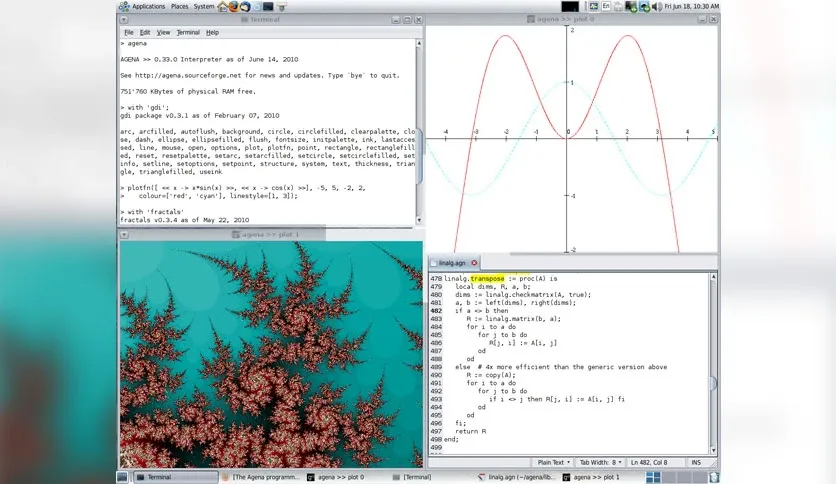
Agena Programming Language is a modern, statically typed language designed for low‑level system programming and rapid prototyping. It blends C‑like syntax with powerful pattern matching and a lightweight runtime that runs on bare metal or as a library inside larger applications. Developers who need deterministic performance and fine‑grained control over memory find Agena a natural fit.
The language offers a clean module system, built‑in concurrency primitives, and a small standard library that covers file I/O, networking, and basic data structures. Its compiler targets both 32‑bit and 64‑bit architectures, generating highly optimized native code. Agena is actively maintained by a community of contributors and is released under a permissive license.
Agena Programming Language Download Latest Version
Main Features
- Static typing with type inference and generic support.
- Zero‑cost abstractions: no runtime overhead for generics or traits.
- First‑class support for async/await and cooperative multitasking.
- Built‑in pattern matching with exhaustive checks.
- Cross‑platform compilation to ELF, Mach‑O, and PE binaries.
- Integrated testing framework and continuous integration hooks.
- Extensible macro system for compile‑time code generation.
- Optional garbage collection for rapid prototyping.
System Requirements and Technical Details
- Operating System: Windows 10+, macOS 10.15+, Linux kernel 4.15+
- Processor: x86_64 or ARM64 with SSE2 support.
- Memory: 2 GB RAM minimum, 4 GB recommended.
- Disk Space: 200 MB free for installation and 1 GB for compiled artifacts.
- Display: 1280×720 minimum resolution.
- Internet: Required for initial download and optional package updates.
Installation and First Use
Download the offline installer from the link above. The installer package contains the compiler, standard library, and documentation. Run the executable, accept the default installation directory, and click “Finish” to complete the setup.
Open a terminal and verify the installation by executing agena --version. The output should display the current compiler version, for example, “agena compiler 2.4”.
To create a new project, run agena init myapp inside the desired folder. This command generates a basic project layout with a main.ag file. Compile the project with agena build and launch the resulting binary with ./myapp. The console should print “Hello, world!” confirming that the compiler and runtime are functioning correctly.
Sample Code Snippets
fn main() {
    let mut counter: i32 = 0;
    while counter < 5 {
        println!("Count: {}", counter);
        counter += 1;
    }
}
This simple loop prints numbers from 0 to 4, demonstrating the language’s syntax and the built‑in println! macro.
async fn fetch_data(url: &str) -> Result {
    let response = http::get(url).await?;
    Ok(response.text().await?)
}
The async function shows Agena’s native support for asynchronous operations and error handling with the Result type.
enum Shape {
    Circle(f64),
    Rectangle(f64, f64),
}
fn area(s: Shape) -> f64 {
    match s {
        Shape::Circle(r) => 3.1415 * r * r,
        Shape::Rectangle(w, h) => w * h,
    }
}
This pattern‑matching example calculates the area of different shapes, illustrating exhaustive matching and tuple destructuring.
Mencari link download asli… menunggu 0 detik. Mohon tunggu, biasanya beberapa puluh detik.