



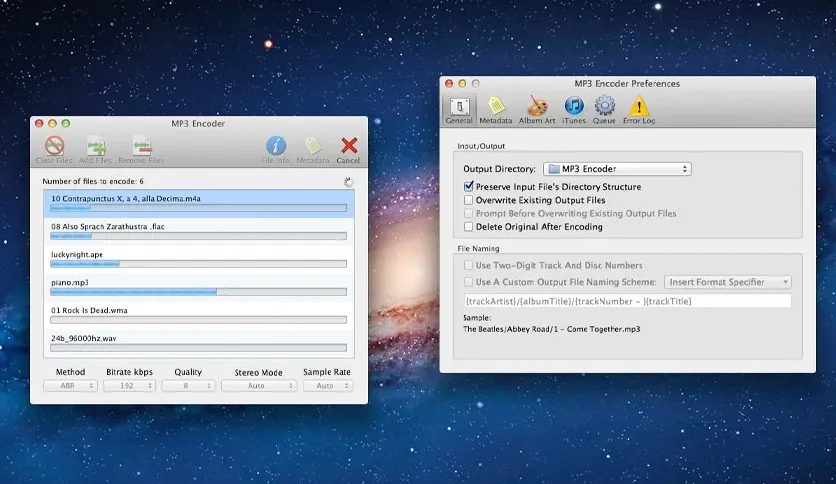
Free Download Mp3 Encoder full version offline installer. This program helps you convert audio tracks to MP3 format quickly on macOS.
Mp3 Encoder Overview
Mp3 Encoder is a dedicated audio conversion utility built specifically for Apple desktop and laptop computers running macOS. Audio engineers, podcasters, and casual listeners use this application to transcode lossless or compressed audio formats into widely compatible MP3 files. The software processes batch queues efficiently while preserving ID3 tags and album art metadata during conversion tasks.
Modern codecs demand reliable hardware utilization, and Mp3 Encoder leverages native CoreAudio frameworks to speed up rendering jobs without maxing out system resources. Users configure custom bitrate targets, variable bitrate profiles, and channel mixing settings through a streamlined graphical interface. The application eliminates unnecessary conversion bloat, focusing entirely on speed and audio fidelity.
Automating repetitive conversion workflows requires scripting support, so advanced users frequently integrate Mp3 Encoder For macOS Download Latest Version into terminal pipelines. Developers write shell scripts to watch hot folders and transcode incoming audio files automatically. This flexibility makes the tool suitable for both desktop users and headless media servers.
Key Features of Mp3 Encoder
- Batch conversion engine processes multiple files simultaneously to save time.
- Customizable VBR and CBR bitrate settings ranging from 64 kbps to 320 kbps.
- Metadata preservation retains artist names, track titles, and cover art.
- Sample rate resampling supports downmixing or upsampling audio streams.
- Built-in command-line interface enables shell script automation.
- Multi-threaded encoding leverages all available CPU cores for faster rendering.
- Drag-and-drop file queue management simplifies user interaction.
Automating batch conversions via shell scripts saves significant time when handling large sound libraries. Below is an example script using LAME encoder command-line arguments equivalent to internal processing:
#!/bin/bash
for file in *.wav; do
  lame -b 320 "$file" "${file%.wav}.mp3"
done
echo "Batch conversion complete."
Users often need to inspect audio file properties before running conversions. The following Python snippet checks sample rates using standard libraries:
import wave

with wave.open("audio_sample.wav", "r") as wav_file:
    channels = wav_file.getnchannels()
    sample_rate = wav_file.getframerate()
    print(f"Channels: {channels}, Rate: {sample_rate} Hz")
System Requirements and Technical Details
- Operating System: macOS 10.13 or later
- Processor: Intel Core i3 or Apple Silicon M-series chip
- RAM: 4 GB RAM minimum
- Hard Disk Space: 200 MB free disk space required
- Display: 1280x800 screen resolution
- Internet: Required for software activation and updates
Extracting audio streams directly from video containers requires pre-processing steps. The script below demonstrates how to extract raw audio using FFmpeg before encoding:
import subprocess

def extract_audio(input_video):
    output_audio = "extracted.wav"
    cmd = ["ffmpeg", "-i", input_video, "-vn", "-acodec", "pcm_s16le", output_audio]
    subprocess.run(cmd, check=True)

extract_audio("input.mp4")
Python's multiprocessing module helps manage large file queues efficiently. The script below distributes encoding tasks across multiple worker processes:
import multiprocessing
import os

def transcode_file(filename):
    mp3_name = filename.replace(".wav", ".mp3")
    os.system(f"lame -V2 {filename} {mp3_name}")

if __name__ == "__main__":
    files = ["track1.wav", "track2.wav", "track3.wav"]
    pool = multiprocessing.Pool(processes=2)
    pool.map(transcode_file, files)
Mp3 Encoder For macOS Download Latest Version Installation Guide
Acquire the setup file from the download link provided on this page and open the disk image. Drag the application icon into the Applications folder shortcut to complete the initial installation. Launch the program from Launchpad, and grant disk access permissions if macOS prompts for security validation during startup.
Resolve common permission errors by adjusting security settings in System Settings under Privacy & Security if the app blocks execution. Repeat this deployment workflow on secondary Apple hardware by copying the installer package over a local network or USB drive. Always use legally obtained software to ensure security and receive legitimate updates.
Mencari link download asli… menunggu 0 detik. Mohon tunggu, biasanya beberapa puluh detik.