



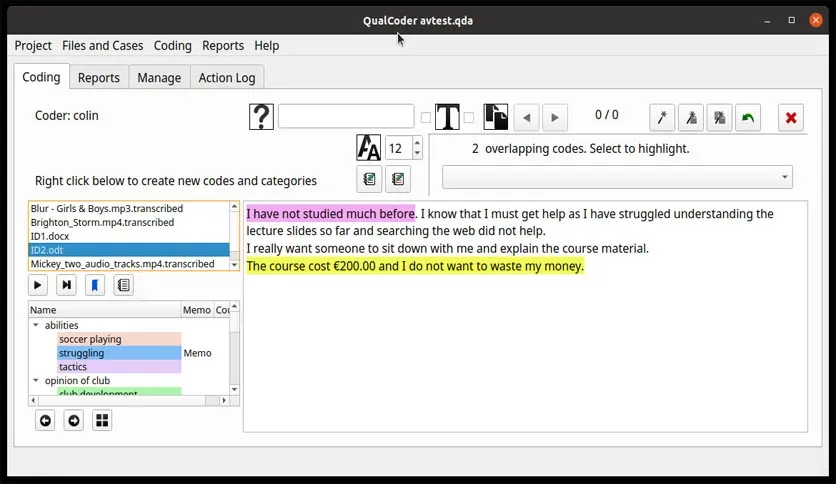
Free Download Qualcoder full version offline installer. This program helps you analyze qualitative data including text, images, audio, and video files.
Qualcoder Download Latest Version Overview
Qualcoder is an open-source Computer Assisted Qualitative Data Analysis Software designed for researchers. Academic investigators, sociologists, and students use this application to code text documents, images, audio, and video.
The platform provides tools for categorizing data, creating memos, and visualizing relationships within complex datasets. SQLite database backend stores all project data securely on local storage.
Users import documents in various formats and apply hierarchical codes to segments of interest. Search queries retrieve coded excerpts across multiple sources for synthesis and reporting.
Key Features of Qualcoder
- Text document coding supports plain text, PDF, and HTML formats.
- Audio and video transcription tools enable direct coding of time-based media segments.
- Image analysis allows region selection and coding of specific visual areas.
- Matrix coding queries compare code co-occurrence across different document categories.
- Visualization tools generate graphs and reports to illustrate data patterns.
- Project backup and restore functions protect research data against loss.
- Multi-language user interface accommodates international research teams.
Python script integration allows custom data manipulation and export tasks. The following code snippet demonstrates how to connect to a Qualcoder project database using Python and query existing source records:
import sqlite3

connection = sqlite3.connect('qda.qda')
cursor = connection.cursor()

cursor.execute('SELECT id, name FROM source')
sources = cursor.fetchall()

for source_id, name in sources:
    print(f'Source ID: {source_id}, Name: {name}')

connection.close()
Researchers often need to export coded data for statistical analysis or external reporting. The following script reads coded segments from the database:
import sqlite3

connection = sqlite3.connect('qda.qda')
cursor = connection.cursor()

query = '''
    SELECT catid, name
    FROM category
'''
cursor.execute(query)

for row in cursor.fetchall():
    print(f'Category ID: {row[0]}, Name: {row[1]}')

connection.close()
System Requirements and Technical Details
- Operating System: Windows 10, Windows 11, macOS, or Linux.
- Processor: Intel Core i3 or equivalent multi-core processor.
- RAM: 4 GB RAM minimum.
- Disk Space: 500 MB available storage for application and project files.
- Display: 1366x768 screen resolution.
- Internet Connection: Required for initial software download and package updates.
Custom coding queries can also be executed programmatically to audit project structures. Use this script to count codes associated with specific sources:
import sqlite3

connection = sqlite3.connect('qda.qda')
cursor = connection.cursor()

cursor.execute('''
    SELECT cid, COUNT(cid)
    FROM codedtext
    GROUP BY cid
''')

for cid, count in cursor.fetchall():
    print(f'Code ID {cid} is used {count} times.')

connection.close()
Installation and Usage Guide
Obtain the setup file from the download link on this page. Run the installer executable and accept default configuration settings to complete the installation process.
Launch the application from your desktop or application menu. Create a new project container and select a secure local directory to store your database.
Import primary documents such as interview transcripts or field notes into the project workspace. Highlight relevant text segments, assign descriptive codes, and verify that the database registers each entry correctly.
Always use legally obtained software packages from verified sources to ensure security and stability.
Mencari link download asli… menunggu 0 detik. Mohon tunggu, biasanya beberapa puluh detik.