




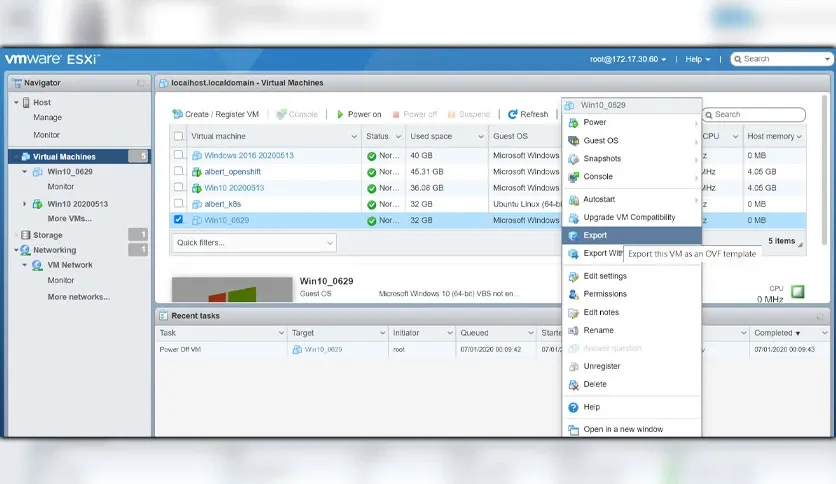
Free Download Vmware Esxi full version offline installer. This program helps you consolidate physical servers into virtual machines to optimize hardware resource utilization.
Vmware Esxi Overview
Vmware Esxi operates as an enterprise-class, type-1 hypervisor developed by Broadcom for deploying and serving virtual computers. Direct installation onto physical server hardware bypasses the need for an underlying operating system, maximizing processing efficiency and minimizing overhead.
Enterprise datacenters, cloud providers, and IT administrators rely on Vmware Esxi to manage complex workloads, ensure high availability, and secure virtualized environments. Native hardware integration allows administrators to partition physical servers into multiple virtual machines, each running its own operating system and applications independently.
Advanced resource management capabilities dynamically allocate CPU, memory, storage, and networking resources across active workloads. Centralized management through vCenter Server enables seamless live migration of virtual machines between physical hosts without downtime, ensuring continuous business operations during hardware maintenance.
Key Features of Vmware Esxi
- Direct-to-metal hypervisor architecture eliminates general-purpose operating system overhead to deliver near-native performance for demanding applications.
- vSphere vMotion functionality permits live migration of running virtual machines between different physical servers without service interruption.
- High Availability monitoring detects hardware failures and automatically restarts affected virtual machines on alternative surviving hosts in the cluster.
- Distributed Resource Scheduler continuously balances computing workloads across clustered servers based on real-time resource utilization metrics.
- Advanced security mechanisms include encrypted virtual machines, secure boot enforcement, and granular role-based access control.
- Software-defined storage integration through vSAN pools direct-attached storage devices to create shared high-performance datastores.
- Comprehensive API support facilitates infrastructure automation, deployment scripting, and integration with third-party monitoring tools.
Vmware Esxi Download Latest Version
Acquiring the correct deployment media ensures compatibility with modern server architectures and firmware requirements. Vmware Esxi Download Latest Version provides access to updated drivers, security patches, and performance enhancements necessary for stable production environments.
Administrators should verify hardware compatibility lists before initiating deployment to ensure seamless integration with existing network adapters, storage controllers, and processors. ISO images can be written to bootable USB drives or mounted via integrated remote management controllers such as iDRAC or iLO for bare-metal installation.
System Requirements and Technical Details
- Processor: Host system requires a valid 64-bit x86 processor with two or more physical cores. Hardware virtualization support must be enabled in the BIOS or UEFI settings.
- RAM: Minimum 4 GB physical memory required for installation, though 8 GB or higher is recommended to support multiple virtual machines.
- Disk Space: Minimum 8 GB boot disk capacity required for installation on USB, SD, SATA, or SAS devices.
- Network: At least one Gigabit or faster Ethernet controller supported by the hypervisor hardware compatibility list.
- Display: VGA or compatible graphics controller supporting standard console output during text-based installation and configuration.
Installation and Initial Configuration Guide
Initiate the deployment process by acquiring the installer from the download link on this page and writing the ISO image to a bootable USB medium. Insert the bootable media into the target server, restart the machine, and select the USB device from the boot menu.
Allow the installer to load necessary drivers and kernel components into memory, then accept the End User License Agreement when prompted. Select the target local storage disk for installation, confirm the warning regarding data overwrite, and input a strong root password to complete the setup process.
Reboot the server after installation finishes and access the Direct Console User Interface using the physical console or remote management tool. Navigate to the network configuration menu to assign a static IPv4 address, subnet mask, and default gateway to ensure network accessibility.
Mencari link download asli… menunggu 0 detik. Mohon tunggu, biasanya beberapa puluh detik.